Showing posts with label Observations. Show all posts

Sunday, February 20, 2022

Everyday We're Shuffling

I only lost it once over the holidays so I consider it a win of a deployment season.

Staying with family feels like coming home. But you can't go home again, "they" say, and I think I see why. You've changed. They've changed. Everything else has changed. That's normal, and I seriously was reminded of that quote while watching The O.C. for the third time and it's funny because the dumbest character says it.

You grow up. That doesn't mean you handle everything with logic and grace. When I open the gates even a little, often the flood comes out.

I was telling Jules again the other day how it's OK to cry. She says, I know but I don't like to cry. Hm. Yeah. Good point. It does suck. I pretty much never feel better. Maybe mentally but not physically and that kind of ruins it.

I miss my co-parent the most. Because we can still talk, text or email, I get my best friend back now and then. But because he's not here to parent, I don't always get his dose of a second opinion when I need it. (Though I did make him put them to bed the other night, listening to his stern voice through the phone while I cleaned up.)

I was coaxing Cole out of my parents' house to go to my siblings' over Thanksgiving break, and it just built and built and I had told my parents to wait in the car, and Jules the peacemaker had stayed over with cousins, and he was fighting me so hard. I wanted him to see he was hurting me, making it hard. So I let myself tear up. His face softened but he didn't budge much. We sat staring at each other and breathing heavily. Me with tears streaming, wishing my husband and his dad was there with us right then and now instead of serving everyone else.

It seemed like everyone always loves hanging out with Jules but not Cole.

Cary would've said, it's just because he's only three. He's not old enough to do full-on sleepovers and be more manageable yet. Remember it's us against the world.

However I couldn't think of that in the moment, on my own.

I couldn't remember how much I love that sweet, wild child exactly as he is at every stage unconditionally always and forever. Couldn't vent. Couldn't download. Couldn't be embraced and supported the way only his father knows how to do best. Not perfect but best.

Yet I'm tired. So when we returned to sunny California from my homey northwest, my angel of a mom-in-law and Grammie-in-law watched the kids while I went to the spa, sitting in the foggy steam room till my eyes felt better finally and where I couldn't even see the sporadic other person in the tiled space.

Then I lay on a pool chair while reading as I watched people ice skating at The Del in bikinis.

Everything isn't so bad.

We all got back in our beloved routine filled with tiny San Diego excursions which breathe life into all of us. Things then continued to get jacked up by random COVID scares. Which always give my heart palpitations and stress despite my best efforts but also moments with my children I wouldn't have had otherwise – which I know one day I'll wish to live twice. I want off this ride but it's life so I guess I don't.

We saw family again another weekend in my husband's hometown. I ran into old college friends while wearing Grammie's coat since she was worried I wouldn't be warm enough at the park (she was right), which was adorable but probably not the coolest item.

Donkeys were everywhere from the Loma Linda hills so Grammie and I dodged their poop with the kids.

I drove out of the way with the kiddos to hit up and stock up at my fave Mexican spot in grad school and realized I feared for our lives. The kids had a blast though taking quarters from a determined homeless man to work the games and vending machines.

Cary's mom came down so I could go to my work holiday party for free but traffic was murder and I still had to leave early to get them from school and daycare. However for that one hour it was so nice to talk shop and not deployment or kids too much. Though when I did with Liz we commiserated over our tough boys, and my heart swelled and kept healing with mutual understanding.

We got matching really cute Christmas pajamas for once this year but mine looked funny on me, Jules' ended up being too tight she admitted though she powered through for 24 hours, and Cole's were adorable but he didn't have the patience for the buttons or the heat. We got some of my favorite, horrible pics though. #worthit

Then Jules got a light-bright type art thing for Christmas and it looks cool in the dark, so while I'm cooking Christmas morning breakfast she calls me and Cole in to check it out. It's dark and needs to be darker; Cole closes the door. We all admire the lit-up drawing. I turn around with spatula in hand to find the door locked from the outside. Shit. I panic for 15 seconds. Jules says it's OK, I can go out the (high, tiny) window. My friends are out of town. One neighbor I know too. I picture us all burning to death from our breakfast or at the very least the fire department showing up or CPS again. LUCKILY, I had my phone on me. So I called my other, closest neighbor (the couple who takes my barrels out and in every Wednesday and it breaks my heart with glee), and she follows my instructions to get in the still-locked-from-the-night house and save us all. Not even making me feel bad. Then brings over goodies they had gotten the kids and I.

God bless them.

I fix the doorknob, figuring out how to turn the knob around the right way with a Phillips and some jimmying. *pat on back*

I fall into bed every night.

Though I hate going to sleep because when I wake up, Cary won't be awake till later afternoon. It's sad and lonely when the person who cares most about us isn’t conscious enough to care.

And what is it about being a parent maybe that makes me cry in every damn movie?

Cary must miss the kids so much.

And we keep losing people in real life. Which breaks my heart for everyone involved.

My heart feels like it can't take much more. Then it can. Like the Grinch's.

I can't go home because I'm this different person who cries in movies and has heart palpitations and stress without being an essential worker or working on Wall Street, but also shuffles through the day rock star style. I think of my Grams sometimes, who would come help these days if we could live and feel good forever, and if anything she would tell me she's proud of my own bravery.

Even though bravery can be selfish, giving can be self-serving, and serving can be a sacrifice that's too much, I still think, Fly Navy. We're almost home.

Saturday, November 13, 2021

In Omnia Paratus: Not So Much

Cary screenshotted us from Okinawa.
A newsletter I get through work has great quotes. They usually make me laugh, or feel happy or encouraged. But this one edition brought up a Latin quote from Gilmore Girls – "in omnia paratus." Or "ready for all things" essentially. I liked it. And then I didn't.

We felt ready for deployment. We were. Prepped to the point of creating ease and paving the way for help and peace of mind. You can't be ready for all things. No one is always coming. Yet we're putting pavement beneath and behind us every moment.

The snails there are huge.

I watched a movie about bears with the kids, and aside from the amazing things mama bears do – like mamas in real life – I mainly resonated with their hibernation, which works for a lot of necessary recharging especially at the beginning of deployment. Then there are the days I commit to two birthday parties for different reasons and stumble into bed feeling tired in my bone marrow.

Jules: Are you gonna be back for my birthday?

Cary: No I'll miss your birthday. And Cole's birthday... And mama's birthday. But I'll be back for mine.

Jules laughs.

For the first few weeks when I'd hear the neighbor's gate or ours when something's delivered, I couldn't help but jump inside thinking it was him.

Cole got potty-trained in the nick of time. Not before pooping at the same friend's house a second time and wondering if pink eye was coming for us this time.

I also don't love when we get home and they didn't eat enough hosted dinner, so now I have to give them second dinner before bed. I don't do it the next time.

With this friend – who dealt with the threat of poop again and kids complaining the sausage is too spicy while falling out of their chairs and screaming – I discuss signing up for things. Swim this time since she's been jumping through hoops like I had several months before. Why is signing kids up for stuff so complicated sometimes? We ponder.

I now drive a minivan. It's my favorite minivan and green and ours with an affordable Nevada plate and doors we don't have to interact with nor seats we have to squish into with guests, but it still killed a little of my soul and chipped away a little of my identity. I wanted to rage against the minivan. But it's a vehicle. And I'm practical. So it's me and can handle the mountains we visit. I buy knock-off expensive sneakers six months later and feel a little bit better too.

We're in the van, just Jules and I heading from after-school care to get Cole from daycare.

Jules: I'm so glad I was born.

The best weekends with this sassy angel and my sour patch kid are spent on the couch with two breakfasts in a row plus an outing where we breathe life into the truck that sits lonely all week. In the evenings or in bed I decompress, sitting in the quiet for a moment and listening to my breath or heart that I think beats too fast these days, feeling solely responsible for them and feeling every pulled muscle from the day. Exhausted but wanting to look at pictures and videos of them on my phone like most parents. Needing alone time but feeling lonely.


Sometimes when I share a schedule idea with the kids... "How about we eat and get ready then go to the library then the park."

Cole says: I like your plan, Mom!

I learn only military spouses understand.

At work the single parents and parents and married couples and former service members or spouses relate. At work, without operating on anyone or operating an aircraft, it's a break and a lovely workout for my brain. It's something that's mine alone, that I can care about with both a selfish and selfless, passionate level of service and skill.

At opposite points in the day, besides the weekend vegetation or sense of adventure, the kids are there and then not there. I can't soak up every detail enough during the day. I want to drink them up and feel them inside me again, keep them safe. However I don't want to be wiggled and kicked against or jumped on, spilled on, sneezed on.

The more I learn, the more I realize how much I don’t know. Albert Einstein.

We all miss Butters.

I want to prove them right. That we can do it.

We're running out of gas and I'm getting used to the van fuel gauge. It's dangerously low suddenly on my way home from work, and I'm not sure exactly how many miles to the base gas station though it's near. After grabbing Jules and then pulling away from Cole's daycare I say I hope we make it.

Cole: "I believe in you, Mom!

Me too.

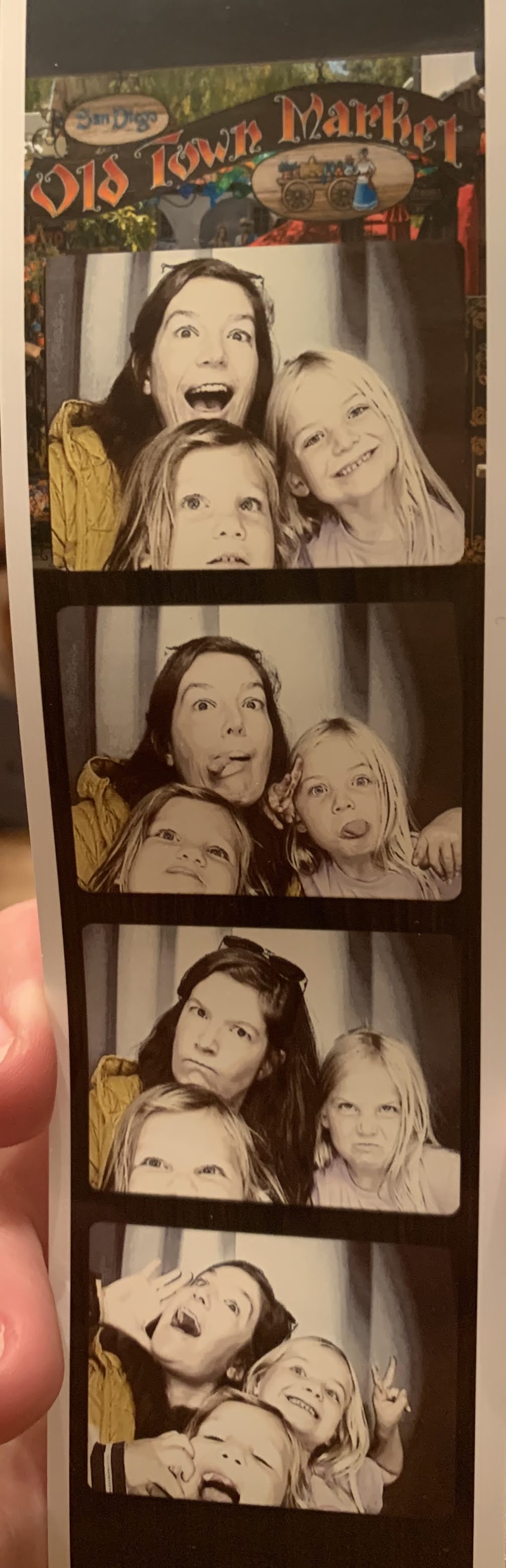
Old Town has been the best excursion yet.

Monday, February 15, 2021

Your Name Here.

Jules writes her name with a big, solid period at the end. So sure of herself it seems. I've noticed other kids do this sometimes as they learn to write and learn punctuation. I like the idea of thinking of ourselves with a firm, confident period at the end of who we are.

Potty training a boy, at least my boy, makes me doubt putting a period at the end of my name.

Anyone else experience that rush of adrenaline, ripping your kid out of a swing or off the couch, or out of the bath, at the hint they're pooping while attempting to potty-train? Then trip getting to the portable potty you brought to the park? Then find you're too late and now that you've pulled their pants down, it's worse than you ever imagined?

You really learn what good friends are when your kid poops their pants at your friends' house and you came unprepared.

Cole taught us over the last year he cannot be trusted to stop having fun to hit the bathroom.

We taught Jules about crying wolf. Spoiler alert: A wolf will petrify any kid into avoiding that. We may have forgotten briefly it eats the sheep and had it eat the boy, our voices slowing down to a quiet trail as we realized what we were doing, her eyes wide in the dark before bedtime, us curled around her on top of the covers. Oops.

There are many immature ways I still feel young but I'm nonetheless getting older (and wiser at an eighth of the rate). Old move: I got a pap smear for my birthday last fall. Immature move: I think I might start doing that yearly because I got a few extra "happy birthday's," giving my birth date to check in and so on.

Let's see, I watched Enola and The Queen's Gambit and fell in love with women all over again.

Oh – I got a new, full-time job! It's been great. Rewarding. Uses my skillset. Makes me feel like a grown-up. It also takes about 30 minutes to explain so I'll spare you.

In other literal news, I got the cover of Crown City Magazine again. In honesty, the key is the photo someone more professional took. Also got a Coronavirus at Christmastime feature for the Coronado Times. You can read more about my island Times life here if you're really, really bored – so these are basically some of my favorite people ever and I wish we could have writer get-togethers which they did before COVID and I arrived.

The writing and income life is good for once. If only I could make time to finish that pesky 30-something coming-of-age novel instead of blogging therapeutically.

I still like how I saw this on Twitter and thought, yep.


Anyone else have an Apple Watch and not know what to do with it? If you have one and do know what to do with it, please tell me. I'm tempted to donate it to someone who needs it. I still love you for getting it for my birthday, Cary, don't get me wrong.

Yet it feels like the giant blue pleather planner I bought when I was 12 and pretty much just enjoyed rewriting my homework assignments in my best (still really bad) handwriting and seeing a five dollar bill in the clear plastic pouch inside.

I proceeded to leave it in every store – racing back in a panic – when I put it down to check out an item.

Cary was gone for some training for a couple weeks recently. The C.B. Strike series on HBO MAX and frozen burritos got me though. Also my amazing mom-in-law. Grandparents may not replace your spouse. They may spoil your kids or not know where everything goes, or not know how to communicate every drop-off, pick-up and chore or errand like your more intuitive spouse after nearly 15 years of marriage. But they sure damn do make it easier when you have to change one less diaper, discipline one less time, deal with one less load of dishes or laundry, make one less even simple meal; and they provide that much more love.

Plus I didn't have to clean the microwave that was laughing at and taunting me. I wanted to shed a tear.

Because when your kids are getting in their car seats, talking incessantly or fighting, and you close the car door on their high, penetrating voices. And you pause. Walk as slowly as possible around to your own car door. It's one break. Adding a grandparent is a whole other one.

Then we drive home, Jules asking me about our our poor dead dog, girls marrying girls, me dying, God, heaven, giving birth (seriously all one in day)... And I’m like, I want them to ask and learn and find their way but also I’m just so tired and can’t even explain these things when tip-top. I mess up these conversations so much. Like I don’t have the answers, kid. Just be a nice person. But like tough when you have to be. Ugghh, good luck.

For some wins – what I live for – we watched Earwig and the Witch (also on HBO), the whole weird thing in peace, both kids rapt, me with coffee I made it all the way through without heating up. And we watched Frozen 2 for the millionth time (still so good) one night while they licked clean bowls of popcorn, also peaceful and laughing together in the near darkness because Jules makes it that way for a "special night" and we were close to her birthday – and I realized how much Cole is absorbing these days, talking about the "ice boat" and the "dark sea." And it's all worth it all over again and again.

Us toward the beginning of the pandemic,
getting ice cream and eating it in the traffic median. 😳

Tuesday, September 29, 2020

These Days Have Teeth

Cole escaped the gate outside our front door. I forgot to latch it in some hubbub, swore he was in our fenced yard, could hear him babbling and banging around. Nope. He had gone 200 feet to the nearest street corner, obsessed with all things vehicular. Oh my good Lord. My heart took the elevator shaft down when I couldn't find him. Springing down the sidewalk, Jules at my heels.

Strangers saved us yet again – but me feeling their hearts and minds, through their eyes, chewing on my soul with sharp, judgmental canines. I thanked profusely, dodged quickly, tried to show I cared the most and shuffled the kids back to the house – embarrassed – wracking my head for the error. Jules? Nope. Me.

The police stopped by (how long had Cole been chilling with these passersby?!). The officers kindly tried to make me feel a little better.

Why did I avoid apologizing to anyone?, I wondered later. Because it's my kid and I'm a good mom? Because I was stretched thin for the longest I've ever been? Because I felt enraged for all the wrongly judged parents, especially moms (let's be honest), especially military spouses or the like, especially these days?

Child Protective Services showed up a few days later, announcing themselves in startling clarity right when I had almost recovered from the lost child incident. My spirit plummeted all over again. My confidence was sapped all over again, trying to find it was probably like getting juice from a prune.

Work hit a distracted standstill, my appetite filled with nerves. Time was lost and a bunch of ache gained. I felt alone alone and like a failure in the HGTV Disneyland that was supposed to be my new home, the village that would help me with my kids and life when Cary isn't able to because he's out helping or preparing to help others.

I felt like the worst parent ever. When I know I'm not. It's a weird dichotomy. These days.

While I waited for a letter that would say the claim was unfounded, I went back near the corner to exchange numbers with a neighbor just in case it helped me feel better, the kids in tow. Jules was eating an apple she wanted to bring and Cole was wearing a fitting Mr. Mischief T-shirt. Make it better for yourself, I thought. And can and did. Notwithstanding a racing heart and worry about cowering to conflict.

In Fallon Jules didn't come inside right away when Cary got home from work one evening. People driving by called the police since apparently the light-glowing house with the front door half open wasn't a clue.

Wulp, I thought that Friday CPS announced themselves at our gate that boasted added security, we officially belong in a garbage can.

Hope no parents have an untidy house, drink alcohol, spank or have junk food around. Because you will feel less than enough even if none of that exists. And your kid will be woken from their nap. And your other kid will all of a sudden clam up. And you better pray it makes for a good wedding toast one day if your rascal survives that long.

I should've taken it more in stride. I should've shook it off sooner. 

Jules actually ran away from us in a Target once, thinking it would be a game while I had visions of someone snatching that tiny little person with the fuzzy hair and running out the front door.

Cole walked straight into the San Diego Bay the other day without his mini lifejacket on, thinking it would be a game too.

I treasure my kids. I'm also surviving them. That's OK.


Loved ones ease my mind. My friends accept me even when I text in weird teen shorthand. Like literally only five years ago my entire message trails were 14-year-old code since I apparently didn't have enough time to write out a complete word (shuttering I think, as a writer). So of course they understand a CPS visit.

One friend listened to me ball into the phone like we were kids again, as the straw had stacked up on top of me. Another said dads get a free pass on mistakes, moms get the authorities. One suggested this will totally be part of a speech at Carroll the Fifth's wedding. This childhood tribe is legit.

Though my buddies are all very different, they seem like they know exactly when to check in on me and how. My military squad can do that too, friends I'm lucky enough to live by again or new ones nearby who don't skip a beat. My heart rippled like a balloon starting to reinflate, slowly healing from all the teeth marks this year is leaving on my soul, many marks much shallower than other people's.

Sometimes I worry I'll have a heart attack or stroke while alone with the kids and they'll find me and panic and not know what to do. Or Cary will be gone and hopefully Jules will know what to do. A heart attack isn't out of realm as the last meal I ordered from Uber Eats left an oiled wood grease stain on a side table (and a chunk out of my wallet).

A bright spot in these months was a job offer. But I turned it down. In our situation, I don't think you could pay me enough these days to do technical writing with still little take-home after the needed nanny or tutor. The second income childcare wash is real precarious these days.

Another bright note: I ordered some scrunchies (so comfy) and a NYC T-shirt (gotta at least wear the dream) to save on shipping when I got sparklers for Jules – after I learned too late Cali doesn't sell fireworks. Thirty dollars later I had saved $10 in shipping. My mind is starting to go.

Cole also burnt his little hand on a sparkler even after a long lecture and with careful eyes. Not careful enough, the voices say. F^@$ off!

Digging through my drawers for other comfortable things to wear every day, I discovered I have several sets of basically yoga pants. Some with pockets! Cell phone-specific pockets! These pants have definitely proven themselves to me and I regret every bad thing I ever thought about them and hope they didn't hear.

I also started the curly girl method toward the beginning of the pandemic. Have you heard of this? Whenever I get low on something in the bathroom or closet, I resort to Instagram to see what items I've saved and might want to try – that aren't one million dollars. Through this I found there's a thing to treat your hair naturally and let its natural wave shine. It's nice but I'm never sure if I should leave the house looking like that.

Good thing because I was all ready to start remote kindergarten, mainly to write about it. Then some go-getter families I'll forever be in debt to started a pod and needed a fifth kid via Facebook. Yet prior to the pod life raft, Jules and I (and Cole) attended a school district parent night via Zoom.

Jules' little head popped over the kitchen bar with me, to meet the amazing teacher and other families whose thought bubbles I would've paid to see. It was so heartfelt but so hilarious. Jules waved, talked, realized no one was responding. She grabbed a toy to show, a banana to eat. Still got bored. Cole pulled me away. Jules and I came back to the screen. We discussed this crazy thing called a mouse.

Their computer experience is going to be so much different than mine was. As well as their nature one.

At the Point Loma Tide Pools Cole said, "Look, Mom!" He had stacked a rectangular rock on top of a larger rectangular rock. "Ah cool!" A few minutes later... "And who's your mother?" Oh crap. A nice older woman (alongside her older man counterpart), who are likely state park volunteers, said they can't have unnatural formations in the park.

"See those rock towers over there?" she said, pointing to the two carefully balanced, small towers of stones perched in holes of the beach cliff wall. "People build them out in nature but they're not natural." She then bent over with her walking stick sprawled to the side and used a hand to awkwardly knock over Cole's very flat tower.

My friend and I proceeded to weirdly tell our adventurous kiddos not to stack rocks.

You never forgive yourself for the real mistakes you make with your kids. But you can move on.

(Plus I love telling that rock story.)

Now I'm going to post this to social media and hopefully make someone else's teeth marks a little less deep.

Saturday, July 25, 2020

Butters Made Everything Better

Butters and Jules when we were in Fallon, Nevada.
We laid our pup of 12 years, age 14, to rest last month.

A night or two later I'm hearing this panting. No other way to describe it. The second night we're laying there in bed and Cary says, You hear that? Me: Yes! Cary: She's haunting us. Me: Yes!

After the third night, turns out the other way to describe it is the house across the street doing a sanding project after-hours.

I miss Butters. Of course. Everyone misses a beloved pet who passes. She was always around for me when no one else could be, grumbling quietly as I warmed my feet on her belly. Her only flaws were she could clear a room and she shed – but when you lower your bar for cleanliness, wear a weirdly repellant flight suit or pajamas to work from home, it doesn't matter much and is worth the trade-off.

Cary liked to show me the vacuum cleaner canister, pointing out all his girls' hair filling it up twice in one cleaning. We three were more than worth it we all agreed.

Loved ones kindly took care of our dog when we needed.

We'll probably never own another dog until maybe our kids are out of the house and we need a ridiculous distraction to fawn over.

We killed our first plant – a cactus – but somehow thought we could manage a dog. She did lose a leg. But we gave kids a shot and it's gone OK so far. Cole has almost died multiple times now though. We profusely thank the stranger, acquaintance or friend who reaches out. Sometimes it's Jules who saves the day, my heart and limbs skittering as if I'm living the chapter Gage gets mowed down in Pet Sematary.

The thing about missing something or someone for me is its nostalgia, wanting what's gone. Even if you have Christmas every year or some vacation to look forward to on the regular, no tradition, period of time or new adventure will ever be the same as it was – as it is, as it's happening right now.

When Kobe Bryant died, I thought of a game I went to with Cary and his friends. The two of us stood for a photo in front of where we exited the Staples Center after a ridiculously fun night. Cary was wearing a hideous mustard yellow shirt with Kobe's face screen-printed on it in purple.

I was hugging Cary sideways for the photo. He pushed my arm away so I wouldn't block his precious player's picture. His friend Larry, who was watching as another friend took the photo, said something like, wow, and smiled and laughed contagiously; he made me crack up too.

I remember this every now and then. That night and funny moment that struck me. All of us young, in school to some extent, some in relationships, just going to a game to watch people who are really good at something. Rooting for something. Laughter and excitement. Now it'll always be a little different watching basketball.

We lost people we actually know and love this year too, and I feel old and sad, realizing life does indeed change in a slow, painful blink. As they say, having kids make the days long and the years short. It's nostalgia with a whole new layer or two, laced with tragedy and crisis. Life comes at us hard and fast and we never know absolutely at all what to expect, more of the same or more change, but both equally hard and necessary.

I feel somewhat awkward and worthless scrounging up freelance work as the papers tighten and marketers raise their bars real high at the influx of candidates. I wonder if I'll be attending a virtual kindergarten alongside Jules next year, juggling Cole between stories about the island or a Carson City press release or my next chapter (*questioning eyebrow raise at myself*). But the bouts of confidence, paychecks and random peaceful hour makes keeping on writing in some form worth every penny and bead of sweat.

I went to help a local author with her website and social media. She lives on a boat and it was cozy but not too cozy and smells like the still sea. I felt we spent the time correcting a Squarespace accounting error but looking back, it was nice to just chat about her life. There's more to existing for me I think than a salary or glittering career, perfect home or people in it. It's a chance to giggle and learn lessons that stick.

Yet don't tell me that when Cary's schedule changes and I have to cut work or play short and watch the kids, or go without a food run or tackled project.

We have plants here the previous tenants made great, and now a goal these days is just to keep them alive. OK, I failed on a couple already but Jules helped me replace them. Like actually helped. She doesn't suck at things so much anymore. And we talked about Butters, which felt good. Jules inserts our pup into her stories and memories. She still sleeps with her stuffed version whose name is also Butters. (We once weighed trimming off the front right leg and sewing it up so it would be a true clone.)

We all talk about those who've passed often; it feels right and keeps them alive to us. It's usually a lesson they taught us or a hilarious story. Which makes me think that's what matters. This year and next is going to have some pretty big learning curves and funny stories to look back on.

I still remember babysitting a friend's little guy when Cary was in flight school. Butters stared at me from the couch: You have no idea what you're doing, do you? I still don't and so I miss her watching over us and always will.

She was there cleaning up the food that dropped (and sometimes didn't), or teaching us how to deal with poop and pee and post-beach dog. She was there having Cary and I talk about our days on humid night walks in Florida. She was there walking Jules to sleep with me along the neighborhood river in Japan. She was there as I cried myself to sleep as Jules was crying herself to sleep. She was there cuddled up close while I pumped milk for Cole. She was there when the daylight in our houses turned dark from a tropical storm or typhoon, both of us listening to the rain and the wind, looking outside as the eyes passed over.

She was there when no one else could be and she didn't lift a paw or say a thing.

Thursday, March 5, 2020

The Bath That Made Us All Dirtier

A lot has changed since I had two kids we somehow named after minerals but spelled differently.

As Jules would say adoringly, in that "tiny town" I had many jobs – more jobs than usual for a military spouse.

I was a reporter before leaving that beloved paper (which taught me a lot) to take advantage of paid maternity leave and a marketing environment. I was laid off because that's how start-ups can go at first. So then I got a new gig out of Carson City that allowed me to work remotely mostly – and kindly continued to do so when our family was being stationed indefinitely in San Diego.

It's nice when the 9-5 is a grind – or when a kid gets sick or Cary has to go be a hero.

Yet then I see people in the flesh, and I throw myself into a rabid conversation of relatable laughing points and stories, AP style discussions or plans for lunch. I also start rambling about all the shows and movies I've watched or stuff read when work is slow or Cary is gone. Sometimes I feel bad for the listener.

I'm sad to change hometowns again. Wherever you learn a lot it feels like home.

I learned I'm bad at being a ballet mom. I would show up in not enough time to get her hair up tight, sweating and having forgotten again to glue her decorative laces so they wouldn't come undone three times during class. She would get kicked out anyway for doing things like playing with the giant stuffed animals they were supposed to be leaping over gracefully.

I learned, in living color, your second child is different from the first. Cole falls asleep on the ground, demands to be read to, leaps off stairs and furniture with his sister, became surprisingly coordinated at a riding scooter early on – and he will sit in Jules' battery-powered truck inside the closed garage, long after the battery dies. He'll study wheels for minutes on end.

I learned I'm still struggling with writing for enjoyment versus writing for pay, or working with a family to take care of when the other caregiver can't be there. More money for my family or that rewarding feeling that oftentimes comes without much compensation or with more snuggles, laughs and memories. Sometimes you do get a bit of everything. But not all at once usually. It may be a never-ending tightrope walk, carefully weighing the stage of life and adjusting your quality of life.

I learned home is where my family is. This one I chose, the one I share a roof with – whether a hotel room, a camper or a home we rent, own or live in on a military base.

I learned when one kid poops in the bath and you have another, both get a lot dirtier. We all do.

I learned being happy is to be grateful. And that I have no good reason not to be.* (Thank you, Downton Abbey.) I've also learned that me letting Cary accept his new position makes me essentially the biggest badass I know. Or the biggest dumbass.

And San Diego? It's like the book Hatchet, only instead of returning to grocery stores I'm faced with an abundance of Targets, ramen shops and dry bars.

*Most of the time.

Saturday, January 16, 2016

The future is fe/male


Emma Watson and her HeForShe campaign
are raising feminism awareness.
I'm slightly concerned the Super Bowl is going to fall on or near Jules' birthday every year. And it's followed by Valentine's Day. If the people in her life who like her think they can get away with Super Bowl parties and Valentine-themed birthday gifts, they better think again... But she'll likely become a better person than her mom and not only love football when the games aren't tight but easily forgo the birthday-relationship worship I apparently not-so-secretly relish. Maybe it'll make her tougher. Like the boy named Sue.

It's hard not to be extra gentle with a baby girl. Why? They all have the same makeup despite the normal variances. Long babies and babies with slightly smaller earlobes or something. They're squishy, don't have kneecaps, are guileless. I did double-takes at first but now I like how with dad home, he wipes her face free of food with more force; he isn't as ginger when putting on her shoes; he tosses her higher and makes her laugh for longer.


Last year I sat around a table of really educated women and found myself describing what a feminist is. I was being stupidly redundant for everyone probably. But it reminded me of when my brother and I were in high school and we were talking about guys and girls and dating ... and we sifted out how a feminist isn't an obnoxiously opinionated woman who doesn't care about men; a feminist is any person who believes in equal rights for all the little boys and girls. If that person also happens to be loud or shy or obnoxious or Emma Watson, it doesn't diminish or elevate the principle beyond what it just plainly is. It's not a personality trait but a belief.

And it has nothing to do with changing the rules so my T-Rex arms are in charge of restraining prisoners or missed career opportunities because I chose to have a kid.

Bro and I thought it interesting how it can be souring when women give their opinions, sometimes loudly, or are anything other than accommodating. Why can a clear voice make us inappropriate, or being submissive make us more attractive? Further, why does a man have to be extra tough or love sports? And why does the choice not to be the breadwinner tend to imply that person's mind, needs and wants are second-rate?

There's something to be said for simply growing up to be the best version of you, a sensitive leader or confident wallflower, maybe appreciating athletes instead of being one, unoffended by turns of phrase, being as little of a wuss as you can be, unabashedly wearing pink or a hoodie or clear high heels.

I was lucky to be with the women around that city patio table, women who've put their sometimes higher-earning jobs on hold indefinitely; women who're raising kids on their own; women who'd do anything for their husbands and vice versa. There are some who aren't fans of military spouses, tossing around the stereotype dependapotamus and taking all the fun out of it, because who doesn't enjoy a good Netflix marathon huh? But have they eaten the food they cook, attended the parties they plan, used the services they provide, enjoyed the free country they help protect on the homefront?

Got a lot of questions here. At least I think this much is true:

Skateboarder Chelsea Castro
Do I want to be the one to investigate things that go bump in the night? Not really. Do I want to be the one to coddle my baby child a little more? Sure! Do Cary and I both eep at cockroaches? Absolutely. Mainly, I want to live in a world, and raise my daughter in a world, where you can be exactly yourself, whoever that may be, and achieve whatever you work hard enough for, and be respected solely because you're a good person.

As returning home comes into view along with high desert life – dry heat, clear cool Lake Tahoe, Burning Man, Area 51, snow-covered sand, the real-life Simpsons house, the Vegas sign graveyard, this really cool thing – I wonder what new progress will flow after our post-holiday move back to 'Merica. Like with the first female Rangers, the new Star Wars star Rey, getting to know more female pilots I can admire as well as new friends and coworkers I can look up to and connect with as peers. The future should be limitless for us all.

"Girl or boy we fight our battles, but the gods let us choose our weapons." – Game of Thrones

Friday, October 2, 2015

Eff

"How ya doin'?"
Tonight Show Host Jimmy Fallon

"Ohh just treading water to keep from the sharks underneath," David says in his New Zealander's voice.

We laugh in the hallway at work because it's dramatic but kind of true. Even when our lives seem small in comparison to CFOs and soldiers, the sense that there are sharp teeth ready to snatch off your toes, or at least nibble at them uncomfortably, is still real.

When Cary's gone, this is just how I feel. But now that Jules and I are over our second illness that deserves a hurricane name ('cause again I'm hyperbolic like that), I think I can handle anything.

Cynically, I give this feeling five minutes.

Before he left, he got off the phone with the skipper, who had the news. "Whidbey?" I ask eagerly from the couch with Jules attached to me and my eyes no longer glued to Mr. Robot, knowing we've been lucky this far - not blessed, lucky - it must/could continue right? We're charmed and good deep down and work so hard...yes, I would like some stinky fatty cheese with my whine.

Tesla Motors (soon-to-be) gigafactory
"Fallon."

#$@&%*!
It's fine.
It's fine.
Teardrop.
What's wrong with you, woman, snap out of it!

Whidbey Island. Pax River. Fallon, Nevada... There was a string of decent options come February 2016. We were on the fence anyway about this one this time around, pop 8,600, shifting its Post-It note on the kitchen wall between top spots. The flying is supposed to be great, search and rescue (SAR), mountain experience, blah, blah, blah, WINK. I love small towns, went to school in one, enjoy driving through them to wherever we're skiing – looking through the diner windows and at the movie theater marquees, romanticizing tumbleweeds and solitary houses set back from the roads, yadda, yadda, yadda.

But I couldn't shake the notion I was moving backward in life, in work-career-job-whatever you wanna call it. Or is it really that our furniture resembles Lisbeth Salander's before she buys grown-up stuff with her hacker money? That seems dumb. Yet everyone else appears to be moving onward and upward with job security and a nearby Pieology and the fruit in the bowl in the fridge with the stuff.

But he did well. And I did too. And we're bright-siders anyway. And hey, don't you want to be us? Have my husband, my kid, my dog, my car, my house. Look we traveled to Seoul. Look we bought a leather couch. Post it, filter it, tweet. Blog about it. We done good, lookit! She sleeps through the night. Butters protects us against cockroaches. Bull. Shit. The truth is nothing is ever perfect and even outside Uncle Sam's Godlike plan and the gloss of social media, no one has control over much. It takes faith in yourself and selflessness, and the great white hope or Hogwarts or whatever you believe in.

And don't let anyone Stepford wife your ass, a friend said, hitting the nail on the head for how I was feeling; it's not only about them, including little people and pets. You'll be running on fumes before you know it because you're human not a robot. Take an interest in yourself and brush off the guilt every time you do what they do: talk about your work, eat til you're full, sleep in, let chores wait.

I will lose it between jobs. I will take a gig reading between bowlers or handing back movie ticket stubs. I will stalk the editor of the local paper until Tesla offers me something I can't refuse or Breaking Bad is filming a second spin-off and needs someone to hold microphones which may dip into the shots. "Jimmy Fallon," I'm coming for you. But in the interim, I'm gonna squeeze the shit out of Japan – from the friends to the trains to the trip that is baby modeling to the ski season to the shortest commute I'll ever have between work, daycare, coffee and store.

There it is, that high again, this time but again from a cathartic (tsk, tsk) blog post I can't resist putting on Facebook because I have nothing else witty to say on there let alone in the flesh in a timely manner. But now I have a bloody nose. Figures. It'd been five minutes. Is it dry in Fallon? Well at least I won't need a blow dryer.

Cary has passed me overseas screening paperwork for the second time in our lives. A friend told me about this; we're moving to a place so remote, it requires a health screening.

None of us can have it all, be the tallest or the bestest, in the ideal place or phase always. Have splendid timing. Still we can at least have our bananas in a hammock if we want, and trust for the best with the rest.

Wednesday, July 30, 2014

Annie's Girl

The very best articles I ever read are always sent from my dad.

* * * * * *


“To make your life being a writer, it’s an auto-slavery … you are both the slave and the task-master.”

Susan Sontag remains one of the most interesting minds in modern history, with provocative and prescient beliefs and opinions on everything from visual culture to love and sex to stereotypes and polarities to why lists appeal to us. But arguably her most timeless insights touch on the heart of her own creative material — literature.

In the spring of 1992, exactly ten years after her magnificent meditation on books in Letter to Borges, Sontag visited the 92nd Street Y in New York to deliver a lecture on the project and purpose of literature. Now, thanks to a new partnership with the Unterberg Poetry Center at the 92Y, who recorded the live event, I am proud and heartened to offer Sontag’s talk for our shared enrichment. Transcribed highlights below — please enjoy.

On becoming a writer, writing itself (a subject Sontag pondered frequently in her diaries), and its osmotic relationship with reading — a fine addition to the collected wisdom of great writers:
What made me be a writer was that I was a passionate reader. I began reading at a very, very early age, and I’ve been a reading junkie ever since — I read all the time. I probably spend more time reading than any other thing I’ve done in my life, including sleeping. I’ve spent many, many days of my life reading eight and ten hours a day, and there’s no day that I don’t read for hours, and don’t ask me how I can do all the other things — I don’t know. The day has pockets — you can always find time to read.
Reading set standards. Reading opened up to me all these norms, or — to put it in a more naive and probably truthful way — ideals. So that to be part of literature, to be even the humblest, lowest member of the great multitude of people who actually dare to put words on paper and publish them, seemed to me the most glorious thing one could do.
Now, in this sort of book-drunken life … in this relation to reading, which is where the writing comes — I didn’t discover I had a talent; I discovered I wanted … to emulate, to honor, by trying to do it myself, as well as continuing to read it and love it and be inspired by it.
And I mean this most passionately. That’s where the standards came from, that’s where the ideas came from of what was good, what was right, what was better, that there was always something better and whatever you could do was by definition not good enough. The only thing that was good was what was hard to do, what you had to work very hard to do, or what was better than anything you could do.
Sontag goes on to explore the still-debated issue of gender in literature and the notion of how stereotypes imprison us:
That all came from books, and it came from the usual books that are now called “the cannon” — used to be called “classics,” which is not a bad term either — and most of those writers are men. It’s not my choice that they be men, but as far as we know, Homer and Shakespeare and Dante and Rabelais and so on, those writers, they’re mostly men. Of course… George Eliot and Virginia Woolf and Emily Dickinson and so on [are] absolutely first-class writers, but most great writers have been men — this is not to justify it, this is not to be happy about it, it’s just the way it is. For all the obvious reasons, we know why the majority of distinguished practitioners of most arts have been, up to this time, men — there’s nothing about the future, nothing about what ought to be, just what is.
Therefore, it was so natural to me to take the attitude that these were writers — in other words, Emily Dickinson isn’t a “woman poet” any more than Walt Whitman is a “male poet” — they’re just both poets. George Eliot isn’t a “woman writer,” whereas, let’s say, Dickens is just a “writer” — they were just writers. . . .
I also live in a time in which it’s very important to me — and natural to me — to support and want to align myself with most aspects of the feminist agenda. I’ve always been a feminist — it’s not something I became. At a certain time, I had the honor of being called by Elizabeth Hardwick “somebody who is born a feminist.”
[But] there can be a contradiction, if you will. It is important to women coming to consciousness of the cultural disabilities under which women labor, in which their consciousness is formed, to make those distinctions — the distinctions that I want to, as a writer, not think about. They can be very important for women in general to think about. So there’s the contradiction — let’s say I do one thing as a citizen, as a civic person, and I do something else as a writer.
[…]
But… if I truly considered people and their lives over a long span of time — people with marriages and love affairs and careers, living in a conventional society — it could not be the case … that I would not be struck by the ways in which women think of themselves in subservient roles and in which they become dependent, or even crippled, by gender stereotypes. … Everybody knows it. What we say is what we have permission to say — we always know much more than we say, and we see much more than we acknowledge that we see, but at any given time there are conventions about what we say we can say and what we think we can think. And one of the interesting things about being a writer is to try to open that out a little bit.
Adding to Italo Calvino’s timeless definitions of what makes a classic, Sontag considers what a writer is and what literature means:
A writer is someone who pays attention to the world — a writer is a professional observer. 
To be a writer, also — and this is the contradiction — demands a going inward and reclusiveness, just plain reclusiveness — not going out — staying home all the time — not going out with everybody else going to play. . . . 
In all of this, I am assuming a certain idea of literature, of a very exalted kind. I’m using the word “writer” to mean someone who creates, or tries to create, literature. And by “literature” I mean — again, very crude definition — books that will really last, books that will be read a hundred years from now.
Now, most people are not “writers” in that sense… 40,000 books a year are published in this country, and many of them are useful and are entertaining to some people. They have some constituency — they’re not part of literature. Literature is actually just this little tiny percentage of what is produced in book form. But, of course, that’s what I’m talking about — I would go as far as to say that no book is worth reading if it isn’t worth reading five times, or more. . . . That’s what I mean by “literature” — a book that you would want, repeatedly, to read, to be inside you, to be part of your bloodstream.
In answering an audience question, Sontag adds her contribution to famous writers’ daily routines, fusing with characteristic elegance the practical and the philosophical:
Writers’ lives are really very boring. I get up in the morning, I make coffee, and I go to work. And I work until I drop. . . . A day in the life of a writer — this writer — is getting up and doing it all day long, and all evening long, and sometimes till 3 or 4 in the morning.
On the psychological value of writing by hand amidst a digital culture, a point that has amplified resonance two decades later:
I write by hand and then I type it. But I have to write the first draft by hand. Now, don’t tell me about the computer — I know the computer is wonderful. I remember one writer friend of mine … said, “I don’t want to use a computer because it’s too entertaining.” It’s not writers’ masochism that makes some few of us continue to hold out against this — it’s that it is better if it goes slower, at least I think so. It’s good to feel it in your hand and it’s good to be able to just think. . . . .
Maybe a writer who grows up with computers would not feel this way, but then, I think, the writing will be different. Let’s put it this way: Writing, like painting, is artisanal. It’s one of the few artistic activities which does require solitude. Most other art activities do involve people and are collaborative. . . . To be an artist or a writer is to be this weird thing — a hand worker in an era of mass production.
In answering another audience question, Sontag considers what it takes to be — rather than become — a writer:
You have to be obsessed. . . . [Being a writer] is not like something you want to be — it’s rather something you couldn’t help but be. But you have to be obsessed. 
Otherwise, of course, it’s perfectly okay to write, in the way that it’s perfectly okay to paint or play a musical instrument — and why shouldn’t people do that? I deplore the fact that only writers can write, as it were? Why can’t people have that as an art activity? … But to actually want to make your life being a writer, it’s an auto-slavery … you are both the slave and the task-master. It’s a very driven thing.
Sontag, who considers herself unproductive despite her books by that point and her ample diaries, returns to the question of daily routines and writerly rituals:
The most productive writers I know have been the most rigidly scheduled, and I’m incapable of having a schedule. . . . Alberto Moravia, the Italian writer who was enormously productive … told me that he started work every morning at a quarter to 8 and he quit at a quarter to 1, and that was it — that’s when he had lunch. . . . And I said, “Well, what happens if you’re called to lunch at a quarter to 1 and you’re in the middle of a sentence?” And he said, “Well, I just stop. I just go and have lunch and go back the next day.” And I thought, I couldn’t do that to save my life. I have a feeling … it’s started! How could? … I can’t leave it! It’s not even that I can’t leave it because I’m afraid that it would go away… I simply can’t.
It’s as hard as stopping peeing in the middle of peeing — excuse the simple-minded example, but just in the same way that it’s very hard to stop peeing once you’ve started, it seems to me, once you’ve started writing, that day, if there’s anything there, how could you stop?
(There’s a reason, indeed, why the creative process at its most immersive is called “flow,” and it’s perhaps this that Henry Miller touched into in his meditation on the joy of urination.)
On the absurdity of using “elitism” as a divisive and derogatory term, something that we still grapple with today:
I think most of what is called “elitist” is a mask for anti-intellectualism — I mean, there is such a thing as excellence.
Sontag ends on a remarkably prescient note about education, the broken system for which she had proposed a revolutionary intervention some two decades prior, and a system that remains just as broken two decades later:
The worst thing about [the system we live in], I suppose, is our educational system. And that is, perhaps, also the most hopeless thing in the system — it’s the most important thing that we should be changing, and it’s the thing we’re least likely to change. And if we don’t change that, basically we won’t change anything else.
Stay tuned for more excellent recordings from the 92Y archives, and explore more of Sontag enduring genius here.

Illustrated portrait of Sontag by Wendy MacNaughton for a previous collaboration

Thursday, January 30, 2014

Late Bloomers

Not by me or even about me, but my dad handed it to me on the beach halfway between my old home and my new.

Why do we equate genius with precocity?
1.
Ben Fountain was an associate in the real-estate practice at the Dallas offices of Akin, Gump, Strauss, Hauer & Feld, just a few years out of law school, when he decided he wanted to write fiction. The only thing Fountain had ever published was a law-review article. His literary training consisted of a handful of creative-writing classes in college. He had tried to write when he came home at night from work, but usually he was too tired to do much. He decided to quit his job.
“I was tremendously apprehensive,” Fountain recalls. “I felt like I’d stepped off a cliff and I didn’t know if the parachute was going to open. Nobody wants to waste their life, and I was doing well at the practice of law. I could have had a good career. And my parents were very proud of me—my dad was so proud of me. . . . It was crazy.”
He began his new life on a February morning—a Monday. He sat down at his kitchen table at 7:30 A.M. He made a plan. Every day, he would write until lunchtime. Then he would lie down on the floor for twenty minutes to rest his mind. Then he would return to work for a few more hours. He was a lawyer. He had discipline. “I figured out very early on that if I didn’t get my writing done I felt terrible. So I always got my writing done. I treated it like a job. I did not procrastinate.” His first story was about a stockbroker who uses inside information and crosses a moral line. It was sixty pages long and took him three months to write. When he finished that story, he went back to work and wrote another—and then another.
In his first year, Fountain sold two stories. He gained confidence. He wrote a novel. He decided it wasn’t very good, and he ended up putting it in a drawer. Then came what he describes as his dark period, when he adjusted his expectations and started again. He got a short story published in Harper’s. A New York literary agent saw it and signed him up. He put together a collection of short stories titled “Brief Encounters with Che Guevara,” and Ecco, a HarperCollins imprint, published it. The reviews were sensational. The Times Book Review called it “heartbreaking.” It won the Hemingway Foundation/PEN award. It was named a No. 1 Book Sense Pick. It made major regional best-seller lists, was named one of the best books of the year by the San Francisco Chronicle, the Chicago Tribune, and Kirkus Reviews, and drew comparisons to Graham Greene, Evelyn Waugh, Robert Stone, and John le Carré.
Ben Fountain’s rise sounds like a familiar story: the young man from the provinces suddenly takes the literary world by storm. But Ben Fountain’s success was far from sudden. He quit his job at Akin, Gump in 1988. For every story he published in those early years, he had at least thirty rejections. The novel that he put away in a drawer took him four years. The dark period lasted for the entire second half of the nineteen-nineties. His breakthrough with “Brief ” came in 2006, eighteen years after he first sat down to write at his kitchen table. The “young” writer from the provinces took the literary world by storm at the age of forty-eight.
2.
Genius, in the popular conception, is inextricably tied up with precocity—doing something truly creative, we’re inclined to think, requires the freshness and exuberance and energy of youth. Orson Welles made his masterpiece, “Citizen Kane,” at twenty-five. Herman Melville wrote a book a year through his late twenties, culminating, at age thirty-two, with “Moby-Dick.” Mozart wrote his breakthrough Piano Concerto No. 9 in E-Flat-Major at the age of twenty-one. In some creative forms, like lyric poetry, the importance of precocity has hardened into an iron law. How old was T. S. Eliot when he wrote “The Love Song of J. Alfred Prufrock” (“I grow old . . . I grow old”)? Twenty-three. “Poets peak young,” the creativity researcher James Kaufman maintains. Mihály Csíkszentmihályi, the author of “Flow,” agrees: “The most creative lyric verse is believed to be that written by the young.” According to the Harvard psychologist Howard Gardner, a leading authority on creativity, “Lyric poetry is a domain where talent is discovered early, burns brightly, and then peters out at an early age.”
A few years ago, an economist at the University of Chicago named David Galenson decided to find out whether this assumption about creativity was true. He looked through forty-seven major poetry anthologies published since 1980 and counted the poems that appear most frequently. Some people, of course, would quarrel with the notion that literary merit can be quantified. But Galenson simply wanted to poll a broad cross-section of literary scholars about which poems they felt were the most important in the American canon. The top eleven are, in order, T. S. Eliot’s “Prufrock,” Robert Lowell’s “Skunk Hour,” Robert Frost’s “Stopping by Woods on a Snowy Evening,” William Carlos Williams’s “Red Wheelbarrow,” Elizabeth Bishop’s “The Fish,” Ezra Pound’s “The River Merchant’s Wife,” Sylvia Plath’s “Daddy,” Pound’s “In a Station of the Metro,” Frost’s “Mending Wall,” Wallace Stevens’s “The Snow Man,” and Williams’s “The Dance.” Those eleven were composed at the ages of twenty-three, forty-one, forty-eight, forty, twenty-nine, thirty, thirty, twenty-eight, thirty-eight, forty-two, and fifty-nine, respectively. There is no evidence, Galenson concluded, for the notion that lyric poetry is a young person’s game. Some poets do their best work at the beginning of their careers. Others do their best work decades later. Forty-two per cent of Frost’s anthologized poems were written after the age of fifty. For Williams, it’s forty-four per cent. For Stevens, it’s forty-nine per cent.
The same was true of film, Galenson points out in his study “Old Masters and Young Geniuses: The Two Life Cycles of Artistic Creativity.” Yes, there was Orson Welles, peaking as a director at twenty-five. But then there was Alfred Hitchcock, who made “Dial M for Murder,” “Rear Window,” “To Catch a Thief,” “The Trouble with Harry,” “Vertigo,” “North by Northwest,” and “Psycho”—one of the greatest runs by a director in history—between his fifty-fourth and sixty-first birthdays. Mark Twain published “Adventures of Huckleberry Finn” at forty-nine. Daniel Defoe wrote “Robinson Crusoe” at fifty-eight.
The examples that Galenson could not get out of his head, however, were Picasso and Cézanne. He was an art lover, and he knew their stories well. Picasso was the incandescent prodigy. His career as a serious artist began with a masterpiece, “Evocation: The Burial of Casagemas,” produced at age twenty. In short order, he painted many of the greatest works of his career—including “Les Demoiselles d’Avignon,” at the age of twenty-six. Picasso fit our usual ideas about genius perfectly.
Cézanne didn’t. If you go to the Cézanne room at the Musée d’Orsay, in Paris—the finest collection of Cézannes in the world—the array of masterpieces you’ll find along the back wall were all painted at the end of his career. Galenson did a simple economic analysis, tabulating the prices paid at auction for paintings by Picasso and Cézanne with the ages at which they created those works. A painting done by Picasso in his mid-twenties was worth, he found, an average of four times as much as a painting done in his sixties. For Cézanne, the opposite was true. The paintings he created in his mid-sixties were valued fifteen times as highly as the paintings he created as a young man. The freshness, exuberance, and energy of youth did little for Cézanne. He was a late bloomer—and for some reason in our accounting of genius and creativity we have forgotten to make sense of the Cézannes of the world.
3.
The first day that Ben Fountain sat down to write at his kitchen table went well. He knew how the story about the stockbroker was supposed to start. But the second day, he says, he “completely freaked out.” He didn’t know how to describe things. He felt as if he were back in first grade. He didn’t have a fully formed vision, waiting to be emptied onto the page. “I had to create a mental image of a building, a room, a façade, haircut, clothes—just really basic things,” he says. “I realized I didn’t have the facility to put those into words. I started going out and buying visual dictionaries, architectural dictionaries, and going to school on those.”
He began to collect articles about things he was interested in, and before long he realized that he had developed a fascination with Haiti. “The Haiti file just kept getting bigger and bigger,” Fountain says. “And I thought, O.K., here’s my novel. For a month or two I said I really don’t need to go there, I can imagine everything. But after a couple of months I thought, Yeah, you’ve got to go there, and so I went, in April or May of ’91.”
He spoke little French, let alone Haitian Creole. He had never been abroad. Nor did he know anyone in Haiti. “I got to the hotel, walked up the stairs, and there was this guy standing at the top of the stairs,” Fountain recalls. “He said, ‘My name is Pierre. You need a guide.’ I said, ‘You’re sure as hell right, I do.’ He was a very genuine person, and he realized pretty quickly I didn’t want to go see the girls, I didn’t want drugs, I didn’t want any of that other stuff,” Fountain went on. “And then it was, boom, ‘I can take you there. I can take you to this person.’ ”
Fountain was riveted by Haiti. “It’s like a laboratory, almost,” he says. “Everything that’s gone on in the last five hundred years—colonialism, race, power, politics, ecological disasters—it’s all there in very concentrated form. And also I just felt, viscerally, pretty comfortable there.” He made more trips to Haiti, sometimes for a week, sometimes for two weeks. He made friends. He invited them to visit him in Dallas. (“You haven’t lived until you’ve had Haitians stay in your house,” Fountain says.) “I mean, I was involved. I couldn’t just walk away. There’s this very nonrational, nonlinear part of the whole process. I had a pretty specific time era that I was writing about, and certain things that I needed to know. But there were other things I didn’t really need to know. I met a fellow who was with Save the Children, and he was on the Central Plateau, which takes about twelve hours to get to on a bus, and I had no reason to go there. But I went up there. Suffered on that bus, and ate dust. It was a hard trip, but it was a glorious trip. It had nothing to do with the book, but it wasn’t wasted knowledge.”
In “Brief Encounters with Che Guevara,” four of the stories are about Haiti, and they are the strongest in the collection. They feel like Haiti; they feel as if they’ve been written from the inside looking out, not the outside looking in. “After the novel was done, I don’t know, I just felt like there was more for me, and I could keep going, keep going deeper there,” Fountain recalls. “Always there’s something—always something—here for me. How many times have I been? At least thirty times.”
Prodigies like Picasso, Galenson argues, rarely engage in that kind of open-ended exploration. They tend to be “conceptual,” Galenson says, in the sense that they start with a clear idea of where they want to go, and then they execute it. “I can hardly understand the importance given to the word ‘research,’ ” Picasso once said in an interview with the artist Marius de Zayas. “In my opinion, to search means nothing in painting. To find is the thing.” He continued, “The several manners I have used in my art must not be considered as an evolution or as steps toward an unknown ideal of painting. . . . I have never made trials or experiments.”
But late bloomers, Galenson says, tend to work the other way around. Their approach is experimental. “Their goals are imprecise, so their procedure is tentative and incremental,” Galenson writes in “Old Masters and Young Geniuses,” and he goes on:
The imprecision of their goals means that these artists rarely feel they have succeeded, and their careers are consequently often dominated by the pursuit of a single objective. These artists repeat themselves, painting the same subject many times, and gradually changing its treatment in an experimental process of trial and error. Each work leads to the next, and none is generally privileged over others, so experimental painters rarely make specific preparatory sketches or plans for a painting. They consider the production of a painting as a process of searching, in which they aim to discover the image in the course of making it; they typically believe that learning is a more important goal than making finished paintings. Experimental artists build their skills gradually over the course of their careers, improving their work slowly over long periods. These artists are perfectionists and are typically plagued by frustration at their inability to achieve their goal.
Where Picasso wanted to find, not search, Cézanne said the opposite: “I seek in painting.”
An experimental innovator would go back to Haiti thirty times. That’s how that kind of mind figures out what it wants to do. When Cézanne was painting a portrait of the critic Gustave Geffroy, he made him endure eighty sittings, over three months, before announcing the project a failure. (The result is one of that string of masterpieces in the Musée ”Orsay.) When Cézanne painted his dealer, Ambrose Vollard, he made Vollard arrive at eight in the morning and sit on a rickety platform until eleven-thirty, without a break, on a hundred and fifty occasions—before abandoning the portrait. He would paint a scene, then repaint it, then paint it again. He was notorious for slashing his canvases to pieces in fits of frustration.
Mark Twain was the same way. Galenson quotes the literary critic Franklin Rogers on Twain’s trial-and-error method: “His routine procedure seems to have been to start a novel with some structural plan which ordinarily soon proved defective, whereupon he would cast about for a new plot which would overcome the difficulty, rewrite what he had already written, and then push on until some new defect forced him to repeat the process once again.” Twain fiddled and despaired and revised and gave up on “Huckleberry Finn” so many times that the book took him nearly a decade to complete. The Cézannes of the world bloom late not as a result of some defect in character, or distraction, or lack of ambition, but because the kind of creativity that proceeds through trial and error necessarily takes a long time to come to fruition.
One of the best stories in “Brief Encounters” is called “Near-Extinct Birds of the Central Cordillera.” It’s about an ornithologist taken hostage by the FARC guerrillas of Colombia. Like so much of Fountain’s work, it reads with an easy grace. But there was nothing easy or graceful about its creation. “I struggled with that story,” Fountain says. “I always try to do too much. I mean, I probably wrote five hundred pages of it in various incarnations.” Fountain is at work right now on a novel. It was supposed to come out this year. It’s late.
4.
Galenson’s idea that creativity can be divided into these types—conceptual and experimental—has a number of important implications. For example, we sometimes think of late bloomers as late starters. They don’t realize they’re good at something until they’re fifty, so of course they achieve late in life. But that’s not quite right. Cézanne was painting almost as early as Picasso was. We also sometimes think of them as artists who are discovered late; the world is just slow to appreciate their gifts. In both cases, the assumption is that the prodigy and the late bloomer are fundamentally the same, and that late blooming is simply genius under conditions of market failure. What Galenson’s argument suggests is something else—that late bloomers bloom late because they simply aren’t much good until late in their careers.
“All these qualities of his inner vision were continually hampered and obstructed by Cézanne’s incapacity to give sufficient verisimilitude to the personae of his drama,” the great English art critic Roger Fry wrote of the early Cézanne. “With all his rare endowments, he happened to lack the comparatively common gift of illustration, the gift that any draughtsman for the illustrated papers learns in a school of commercial art; whereas, to realize such visions as Cézanne’s required this gift in high degree.” In other words, the young Cézanne couldn’t draw. Of “The Banquet,” which Cézanne painted at thirty-one, Fry writes, “It is no use to deny that Cézanne has made a very poor job of it.” Fry goes on, “More happily endowed and more integral personalities have been able to express themselves harmoniously from the very first. But such rich, complex, and conflicting natures as Cézanne’s require a long period of fermentation.” Cézanne was trying something so elusive that he couldn’t master it until he’d spent decades practicing.
This is the vexing lesson of Fountain’s long attempt to get noticed by the literary world. On the road to great achievement, the late bloomer will resemble a failure: while the late bloomer is revising and despairing and changing course and slashing canvases to ribbons after months or years, what he or she produces will look like the kind of thing produced by the artist who will never bloom at all. Prodigies are easy. They advertise their genius from the get-go. Late bloomers are hard. They require forbearance and blind faith. (Let’s just be thankful that Cézanne didn’t have a guidance counsellor in high school who looked at his primitive sketches and told him to try accounting.) Whenever we find a late bloomer, we can’t but wonder how many others like him or her we have thwarted because we prematurely judged their talents. But we also have to acccept that there’s nothing we can do about it. How can we ever know which of the failures will end up blooming?
Not long after meeting Ben Fountain, I went to see the novelist Jonathan Safran Foer, the author of the 2002 best-seller “Everything Is Illuminated.” Fountain is a graying man, slight and modest, who looks, in the words of a friend of his, like a “golf pro from Augusta, Georgia.” Foer is in his early thirties and looks barely old enough to drink. Fountain has a softness to him, as if years of struggle have worn away whatever sharp edges he once had. Foer gives the impression that if you touched him while he was in full conversational flight you would get an electric shock.
“I came to writing really by the back door,” Foer said. “My wife is a writer, and she grew up keeping journals—you know, parents said, ‘Lights out, time for bed,’ and she had a little flashlight under the covers, reading books. I don’t think I read a book until much later than other people. I just wasn’t interested in it.”
Foer went to Princeton and took a creative-writing class in his freshman year with Joyce Carol Oates. It was, he explains, “sort of on a whim, maybe out of a sense that I should have a diverse course load.” He’d never written a story before. “I didn’t really think anything of it, to be honest, but halfway through the semester I arrived to class early one day, and she said, ‘Oh, I’m glad I have this chance to talk to you. I’m a fan of your writing.’ And it was a real revelation for me.”
Oates told him that he had the most important of writerly qualities, which was energy. He had been writing fifteen pages a week for that class, an entire story for each seminar. “Why does a dam with a crack in it leak so much?” he said, with a laugh. “There was just something in me, there was like a pressure.”
As a sophomore, he took another creative-writing class. During the following summer, he went to Europe. He wanted to find the village in Ukraine where his grandfather had come from. After the trip, he went to Prague. There he read Kafka, as any literary undergraduate would, and sat down at his computer.
“I was just writing,” he said. “I didn’t know that I was writing until it was happening. I didn’t go with the intention of writing a book. I wrote three hundred pages in ten weeks. I really wrote. I’d never done it like that.”
It was a novel about a boy named Jonathan Safran Foer who visits the village in Ukraine where his grandfather had come from. Those three hundred pages were the first draft of “Everything Is Illuminated”—the exquisite and extraordinary novel that established Foer as one of the most distinctive literary voices of his generation. He was nineteen years old.
Foer began to talk about the other way of writing books, where you painstakingly honed your craft, over years and years. “I couldn’t do that,” he said. He seemed puzzled by it. It was clear that he had no understanding of how being an experimental innovator would work. “I mean, imagine if the craft you’re trying to learn is to be an original. How could you learn the craft of being an original?”
He began to describe his visit to Ukraine. “I went to the shtetl where my family came from. It’s called Trachimbrod, the name I use in the book. It’s a real place. But you know what’s funny? It’s the single piece of research that made its way into the book.” He wrote the first sentence, and he was proud of it, and then he went back and forth in his mind about where to go next. “I spent the first week just having this debate with myself about what to do with this first sentence. And once I made the decision, I felt liberated to just create—and it was very explosive after that.”
If you read “Everything Is Illuminated,” you end up with the same feeling you get when you read “Brief Encounters with Che Guevara”—the sense of transport you experience when a work of literature draws you into its own world. Both are works of art. It’s just that, as artists, Fountain and Foer could not be less alike. Fountain went to Haiti thirty times. Foer went to Trachimbrod just once. “I mean, it was nothing,” Foer said. “I had absolutely no experience there at all. It was just a springboard for my book. It was like an empty swimming pool that had to be filled up.” Total time spent getting inspiration for his novel: three days.
5.
Ben Fountain did not make the decision to quit the law and become a writer all by himself. He is married and has a family. He met his wife, Sharon, when they were both in law school at Duke. When he was doing real-estate work at Akin, Gump, she was on the partner track in the tax practice at Thompson & Knight. The two actually worked in the same building in downtown Dallas. They got married in 1985, and had a son in April of 1987. Sharie, as Fountain calls her, took four months of maternity leave before returning to work. She made partner by the end of that year.
“We had our son in a day care downtown,” she recalls. “We would drive in together, one of us would take him to day care, the other one would go to work. One of us would pick him up, and then, somewhere around eight o’clock at night, we would have him bathed, in bed, and then we hadn’t even eaten yet, and we’d be looking at each other, going, ‘This is just the beginning.’ ” She made a face. “That went on for maybe a month or two, and Ben’s like, ‘I don’t know how people do this.’ We both agreed that continuing at that pace was probably going to make us all miserable. Ben said to me, ‘Do you want to stay home?’ Well, I was pretty happy in my job, and he wasn’t, so as far as I was concerned it didn’t make any sense for me to stay home. And I didn’t have anything besides practicing law that I really wanted to do, and he did. So I said, ‘Look, can we do this in a way that we can still have some day care and so you can write?’ And so we did that.”
Ben could start writing at seven-thirty in the morning because Sharie took their son to day care. He stopped working in the afternoon because that was when he had to pick him up, and then he did the shopping and the household chores. In 1989, they had a second child, a daughter. Fountain was a full-fledged North Dallas stay-at-home dad.
“When Ben first did this, we talked about the fact that it might not work, and we talked about, generally, ‘When will we know that it really isn’t working?’ and I’d say, ‘Well, give it ten years,’ ” Sharie recalled. To her, ten years didn’t seem unreasonable. “It takes a while to decide whether you like something or not,” she says. And when ten years became twelve and then fourteen and then sixteen, and the kids were off in high school, she stood by him, because, even during that long stretch when Ben had nothing published at all, she was confident that he was getting better. She was fine with the trips to Haiti, too. “I can’t imagine writing a novel about a place you haven’t at least tried to visit,” she says. She even went with him once, and on the way into town from the airport there were people burning tires in the middle of the road.
“I was making pretty decent money, and we didn’t need two incomes,” Sharie went on. She has a calm, unflappable quality about her. “I mean, it would have been nice, but we could live on one.”
Sharie was Ben’s wife. But she was also—to borrow a term from long ago—his patron. That word has a condescending edge to it today, because we think it far more appropriate for artists (and everyone else for that matter) to be supported by the marketplace. But the marketplace works only for people like Jonathan Safran Foer, whose art emerges, fully realized, at the beginning of their career, or Picasso, whose talent was so blindingly obvious that an art dealer offered him a hundred-and-fifty-franc-a-month stipend the minute he got to Paris, at age twenty. If you are the type of creative mind that starts without a plan, and has to experiment and learn by doing, you need someone to see you through the long and difficult time it takes for your art to reach its true level.
This is what is so instructive about any biography of Cézanne. Accounts of his life start out being about Cézanne, and then quickly turn into the story of Cézanne’s circle. First and foremost is always his best friend from childhood, the writer Émile Zola, who convinces the awkward misfit from the provinces to come to Paris, and who serves as his guardian and protector and coach through the long, lean years.
Here is Zola, already in Paris, in a letter to the young Cézanne back in Provence. Note the tone, more paternal than fraternal:
You ask me an odd question. Of course one can work here, as anywhere else, if one has the will. Paris offers, further, an advantage you can’t find elsewhere: the museums in which you can study the old masters from 11 to 4. This is how you must divide your time. From 6 to 11 you go to a studio to paint from a live model; you have lunch, then from 12 to 4 you copy, in the Louvre or the Luxembourg, whatever masterpiece you like. That will make up nine hours of work. I think that ought to be enough.
Zola goes on, detailing exactly how Cézanne could manage financially on a monthly stipend of a hundred and twenty-five francs:
I’ll reckon out for you what you should spend. A room at 20 francs a month; lunch at 18 sous and dinner at 22, which makes two francs a day, or 60 francs a month. . . . Then you have the studio to pay for: the Atelier Suisse, one of the least expensive, charges, I think, 10 francs. Add 10 francs for canvas, brushes, colors; that makes 100. So you’ll have 25 francs left for laundry, light, the thousand little needs that turn up.
Camille Pissarro was the next critical figure in Cézanne’s life. It was Pissarro who took Cézanne under his wing and taught him how to be a painter. For years, there would be periods in which they went off into the country and worked side by side.
Then there was Ambrose Vollard, the sponsor of Cézanne’s first one-man show, at the age of fifty-six. At the urging of Pissarro, Renoir, Degas, and Monet, Vollard hunted down Cézanne in Aix. He spotted a still-life in a tree, where it had been flung by Cézanne in disgust. He poked around the town, putting the word out that he was in the market for Cézanne’s canvases. In “Lost Earth: A Life of Cézanne,” the biographer Philip Callow writes about what happened next:
Before long someone appeared at his hotel with an object wrapped in a cloth. He sold the picture for 150 francs, which inspired him to trot back to his house with the dealer to inspect several more magnificent Cézannes. Vollard paid a thousand francs for the job lot, then on the way out was nearly hit on the head by a canvas that had been overlooked, dropped out the window by the man’s wife. All the pictures had been gathering dust, half buried in a pile of junk in the attic.
All this came before Vollard agreed to sit a hundred and fifty times, from eight in the morning to eleven-thirty, without a break, for a picture that Cézanne disgustedly abandoned. Once, Vollard recounted in his memoir, he fell asleep, and toppled off the makeshift platform. Cézanne berated him, incensed: “Does an apple move?” This is called friendship.
Finally, there was Cézanne’s father, the banker Louis-Auguste. From the time Cézanne first left Aix, at the age of twenty-two, Louis-Auguste paid his bills, even when Cézanne gave every indication of being nothing more than a failed dilettante. But for Zola, Cézanne would have remained an unhappy banker’s son in Provence; but for Pissarro, he would never have learned how to paint; but for Vollard (at the urging of Pissarro, Renoir, Degas, and Monet), his canvases would have rotted away in some attic; and, but for his father, Cézanne’s long apprenticeship would have been a financial impossibility. That is an extraordinary list of patrons. The first three—Zola, Pissarro, and Vollard—would have been famous even if Cézanne never existed, and the fourth was an unusually gifted entrepreneur who left Cézanne four hundred thousand francs when he died. Cézanne didn’t just have help. He had a dream team in his corner.
This is the final lesson of the late bloomer: his or her success is highly contingent on the efforts of others. In biographies of Cézanne, Louis-Auguste invariably comes across as a kind of grumpy philistine, who didn’t appreciate his son’s genius. But Louis-Auguste didn’t have to support Cézanne all those years. He would have been within his rights to make his son get a real job, just as Sharie might well have said no to her husband’s repeated trips to the chaos of Haiti. She could have argued that she had some right to the life style of her profession and status—that she deserved to drive a BMW, which is what power couples in North Dallas drive, instead of a Honda Accord, which is what she settled for.
But she believed in her husband’s art, or perhaps, more simply, she believed in her husband, the same way Zola and Pissarro and Vollard and—in his own, querulous way—Louis-Auguste must have believed in Cézanne. Late bloomers’ stories are invariably love stories, and this may be why we have such difficulty with them. We’d like to think that mundane matters like loyalty, steadfastness, and the willingness to keep writing checks to support what looks like failure have nothing to do with something as rarefied as genius. But sometimes genius is anything but rarefied; sometimes it’s just the thing that emerges after twenty years of working at your kitchen table.
“Sharie never once brought up money, not once—never,” Fountain said. She was sitting next to him, and he looked at her in a way that made it plain that he understood how much of the credit for “Brief Encounters” belonged to his wife. His eyes welled up with tears. “I never felt any pressure from her,” he said. “Not even covert, not even implied.”

Source. © Malcolm Gladwell - an essay pulled from The New Yorker and his latest book What the Dog Saw.